

In The News
Arizona State University Participated in the Launch of the OECD Report on Mexico’s Semiconductor Ecosystem
Mexico City, February 27, 2026 — Arizona State University (ASU) participated in the launch of the OECD report “Promoting the Development of Mexico’s Semiconductor Ecosystem,” co-organized by Mexico’s Secretariat of Economy and the OECD Secretariat in Mexico City.
The report presented a comprehensive assessment of the challenges and opportunities shaping Mexico’s role in the global semiconductor value chain, highlighting the importance of talent development, curriculum alignment, institutional coordination, and integration into global markets.
During the high-level panel, Jeffrey Goss, Executive Director of Global Outreach and Extended Education at the Ira A. Fulton Schools of Engineering at ASU, emphasized that Mexico’s primary challenge is not a lack of talent, but the need for stronger systemic alignment.
Mexico does not lack talent; it requires faster coordination and deeper integration between public policy, industry, and higher education to scale competitively,” Goss stated. “A sustainable semiconductor ecosystem demands long-term alignment across these sectors.
He underscored that curriculum modernization must be dynamic and co-designed with industry. At ASU, modular and stackable credentials — including micro-badges, certificates, and graduate pathways — allow learners and working professionals to upskill and specialize in areas such as semiconductor manufacturing, packaging, and integrated circuit design. Industry partners play an active role in curriculum shaping, teaching, and sponsoring applied projects, ensuring strong alignment between education and workforce needs.
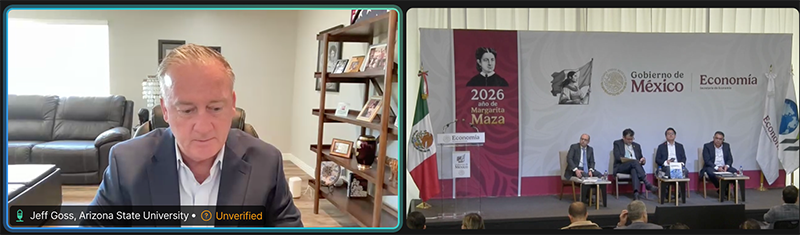
Goss also highlighted faculty development as a critical lever for competitiveness. Through train-the-trainer models, faculty master classes, and curriculum exchange initiatives, ASU has supported institutional capacity building internationally. In Mexico, ASU’s English for Semiconductors initiative, implemented in partnership with TecNM, has reached more than 25,000 participants, strengthening sector-specific English proficiency as a key enabler of global integration.
Expanding the talent pipeline beyond traditional university pathways was another key theme. Goss noted the importance of engaging high school systems, promoting applied STEM learning, and strengthening vocational and apprenticeship models. Semiconductor ecosystems require not only engineers but also technicians and operators, making diversified education pathways essential to scaling the industry. ASU’s participation reaffirmed its long-term commitment to partnering with Mexico to modernize curricula, strengthen faculty capacity, and develop globally competitive semiconductor talent ecosystems aligned with industrial strategy and economic growth.